
Built for Ultrasound Precision
True blacks. High contrast. Wide viewing angles. Fast response. Rich color.
Lincoln Technology Solutions delivers advanced medical display solutions. Our advanced visualization products are designed for seamless integration into surgical monitors, radiology monitor systems, diagnostic ultrasound, pathology, microscopy, endoscopy and clinical imaging platforms.
Our display solutions support demanding medical environments where image accuracy, reliability, and long-term performance are critical. We partner with healthcare dispaly, medical OEMs and system manufacturers to deliver OLED, Mini-LED, and advanced LCD display technologies for diagnostic and surgical use.
High-performance medical systems are heavily relied upon by doctor and patient equally. Our expert engineering and ongoing R&D advancements in display technology, produces superior performance, clarity, contrast, brightness and color gamut. Providing invaluable diagnostic capabilities, renders color, tissue and other structures clearly during surgical procedures.
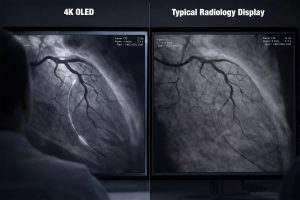
With 4K OLED, medical products are truly high performing. When comparing a side-by-side visual of a 4K OLED vs. a typical display system, the difference is striking. Further, it’s high-contrast, high-resolution helps medical professionals quickly identify important structures such as a vessels, and catheter/guidewires. You won’t hear, “I know it’s there, but I have to work to see it”.
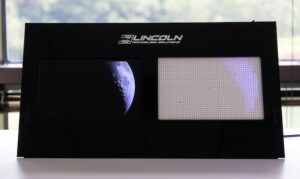
Yes – when engineered correctly.
Our OLED panels mitigate burn-in risk through:
In radiology environments, static UI elements are typically limited to toolbars at the screen edges. Consequently, any minor wear remains peripheral and does not impact diagnostic image quality. To read more in depth coverage on OLED burn-in for medical visualization systems check out our blog on the subject.
For applications requiring high brightness, long lifetimes, and sustained 24/7 operation, mini-LED Full Array Local Dimming (FALD) shines best. For more in-depth information, review our Mini-LED page.

Straining to see details?
OLED has no backlight glow so you can see subtle grayscale differences.

Not enough contrast?
FALD + OLED deliver true blacks and HDR precision, perfect for Radiology Reading and Diagnostic Ultrsound.

Battery draining too fast?
Mini-LED CSP saves up to 75% power with uniform brightness.

Challening color spectrum?
With 4K OLED, colors appear more accurate & precise, making it easier to discern subtle tissue variations.

Portable viewing needs clarity & less weight?
OLED gives high contrast, fast response times, all while being light-weigh.

Still struggling with application fit?
We build custom displays — and take on the complex projects others avoid.
 Radiology
  Diagnostic Ultrasound
  Endoscopy
  Digital Pathology
  Interventional Radiology
  Patient Monitoring
| Your Challenge | Our Solution |
|---|---|
| Viewing subtle differences in x-rays | Less ambient light reflection results in true black |
| Slower response times creating blur or choppy scrolling | Faster response times creating smoother CT/MR/DBT image scrolling |
| Challenging to view specific areas of x-ray | Brightness boosting highlights areas of interest |
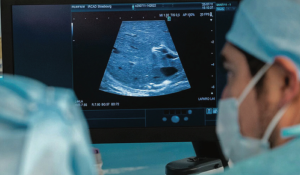
| Your Challenge | Our Solution |
|---|---|
| Difficult to view variances in imaging | Higher contrast ratio with true blacks deepening dynamic range |
| Color inaccuracy | Wide color gamut creates more precise Doppler colors |
| Slow image rendering | Fast response time rendering real-time imaging, no motion artifacts |
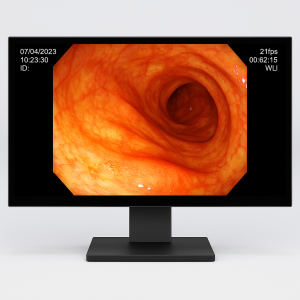
| Your Challenge | Our Solution |
|---|---|
| Display lacks color resolution | Wide color gamut, colors appear more acccurate and precise |
| Challenging to discern tissue variations | High resoltion and wide color gamut help discern subtle tissue variations |
| Slow imaging response | Fast and accurate imaging, low-latency and blur-free performance |
| Your Challenge | Our Solution |
|---|---|
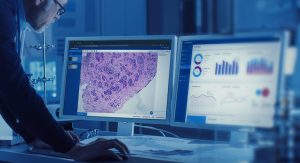
| Colors and and clarity cause diagnostic issues | Enhances tissue structures and staining differences with gamut coverage 99% DCI-P3. |
| Glare and reflections distort framing during outdoor shoots | Daylight-proof brightness. Up to 5000 nits with anti-reflective coating ensures perfect visibility under harsh sunlight. |
| Video lag affects real-time framing and movement precision | Low-latency response. <5 ms response time keeps live footage synchronized with camera motion. |

| Your Challenge | Our Solution |
|---|---|
| Fine details can get lost such as vessels & catheter guidewires | Ultra-sharp 4K resolution and brightness. Captures subtle structures, reduces eye strain, and can increase productivity. |
| Image response can produce blur & low-latency | Fast response time = Improved hand-eye coordination, reducing fatigue |
| Your Challenge | Our Solution |
|---|---|
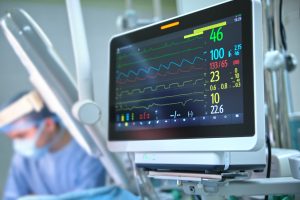
| Contrast with waveforms and other vitals are not clear | True blacks accentuate waveforms and vitals with deep contrast |
| Visibility compromised by glare from bright light conditions | Clear viewing under bright lights. High-bright Mini-LED FALD displays up to 2800 nits. Maintains visibility in environments with bright lights and reflective conditions. |
| Glare from lights can obscure waveforms and other vitals | Anti-Refletive & Anti-Fingerprint means easy quick viewing and confidence |


Tell us your requirements. We will recommend the best fit and ship a sample.


A medical display panel is the internal display component, while a medical monitor is a finished system that includes housing, electronics, power supply, and regulatory certification. LTS supplies display panels for integration into medical systems, working with OEMs and medical device manufacturers rather than producing compete monitors.
High contrast allows clinicians to better distinguish subtle differences in tissue, vessels, and structures. Low-contrast displays can obsqure fine details, particularly in radiology, ultrasound, and interventional procedures. OLED and Mini-LED display panels provide enhanced contrast to support improved visualization.
OLED display panels offer:
These characteristics make OLED panels well-suited for ultrasound, endoscopy, and interventional imaging, applications where detail and motion clarity are critical.
Mini-LED Full Array Local Dimming (FALD) display panels use thousands of small LEDs to precisely control backlight zones. This improves brightness uniformity, reduces halo artifacts, and enhances contrast, making Mini-LED panels ideal for radiology, surgical visualization, and patient monitoring applications.
OLED display panels can be used in certain radiology and interventional imaging applications where motion clarity, contrast, and real-time visualization are priorities. Panel selection depends on the specific workflow, brightness requirements, and system design considerations determined by the OEM or system integrator.
Higher-resolution display panels allow clinicians to see finer anatomical details and color Doppler information more clearly. 4K OLED and Mini-LED display panels support improved detail visibility, helping enhance confidence during ultrasound examinations and procedures.
Yes. Displays with uneven brightness, glare, low contrast, or poor color accuracy can increase eye strain during long procedures. Display panels with uniform luminance, controlled brightness, and high contrast can help reduce visual fatigue and support prolonged clinical use.
No. We provide display panels and integration support. FDA clearance and medical device manufacturers or system integrator as part of the final product certification process.
A “medical grade display” refers to a display component designed to meet the performance, reliability, and consistency requirements of medical imaging environments. This typically includes high resolution, accurate grayscale and color reproduction, stable brightness, strong contrast performance, and long-term reliability for continuous clinical use. In medical systems, the display panel is a critical part of achieving medical-grade image quality, while regulatory certification and final compliance are handled at the complete device or monitor level by the medical equipment manufacturer.
Yes. We work with OEMs and system manufacturers to support custom display panel selection, integration, testing, and development for medical imaging systems across ultrasound, radiology, surgical, and monitoring applications.
OLED and Mini-LED display panels are commonly used in:
Panel technology is selected based on brightness, contrast, power efficiency, and system design needs.
Display panels directly influence how accurately clinicians can interpret medical images. Resolution, contrast, brightness uniformity, and response time all affect visualization quality, making the display panel a critical component in medical imaging systems.
© Copyright 2024 – present Lincoln Technology Solutions. All Rights Reserved.
Designed and Maintained by MRN Designs


