

Overview
This article explains what OLED burn-in is, why it occurs, and how it applies to medical imaging environments. It covers how modern medical-grade OLED displays are engineered to reduce burn-in risk and maintain consistent image quality over time.
Engineering Approaches to Managing OLED Burn-In
The medical field has changed and advanced over the years with innovations in technology. Utilizing display technologies for treatment, clinical, diagnostic, procedural, and therapeutic applications has become standard practice in everyday clinical use where image accuracy, consistency, and reliability are critical. As display advancements occur, the medical field often adopts these changes into their practices. Concerns over OLED burn-in have slowed adoption in medical imaging systems. Below, we discuss the challenges and solutions that may lead medical product designers and manufacturers to recognize OLED as a unique value proposition to their clients when investing in new medical systems.
(Head over to our Medical Display Solutions page to view our full high-performance recommendations)
One question continues to surface among product development and engineering teams.
Is OLED susceptible to burn-in, and does it affect diagnostic image quality?
Yes, OLED is susceptable to burn-in, however, our engineering solutions have solved this issue. OLED blue subpixels typically age faster than red or green and can contribute to burn-in. To address this, our OLED panels use an RGBB pixel structure with two blue subpixels, effectively distributing the load and extending overall blue lifetime. We also employ an adaptive algorithm that gradually increases blue subpixel drive current to maintain consistent brightness throughout the panel’s operational life.
Is OLED suitable for Medical Imaging?
Yes, OLED displays are suitable for medical imaging applications, including radiology reading, interventional radiology, ultrasound, microscopy, endoscopy, and pathology when properly engineered and deployed.
Early concerns around OLED adoption in medical environments focused on sustained brightness performance, pixel aging, and long-term luminance stability. Today, innovations in display panel architecture, enhanced electronics, and advanced compensation algorithms have been developed to directly mitigate these concerns.
Why OLED Burn-In Is a Common Concern in Medical Displays
Burn-in results from uneven pixel aging. In OLED displays, this can occur if the same interface elements remain fixed at high brightness levels for extended periods.
In medical environments, the concern typically centers on:
- Persistent toolbars or UI overlays
- Repetitive workflows
- Long daily usage cycles
However, these concerns must be evaluated in the context of how medical images are actually used.
How OLED Panels Age Over Time
OLED pixels are self-emissive, meaning each pixel produces its own light. Over time, organic materials gradually degrade, which can lead to brightness differences if not properly managed.
Our Engineering Approach to Managing OLED Burn-In
It’s critical consumer grade OLED panels should not be used in medical visualization. Further, a range of engineering approaches should be used to maintain optimal display performance over time.
We apply this disciplined approach in the development of high-quality medical display panels and electronics to ensure reliable clinical consistency.
Key approaches include:
- Optimized subpixel design to extend pixel lifespan utilizing RGBB
- Adaptive drive algorithms that maintain consistent brightness
- Uniformity correction to prevent localized wear
- Higher brightness panels to provide sufficient headroom for pixel-aging compensation
Why Radiology Image Reading Does Not Pose A Risk of Burn-In
A critical distinction in medical imaging is image behavior. To clarify, although static images are viewed, they are constantly manipulated and don’t remain on the screen for long periods of time.
- Every image is different
- Windowing and leveling
- Zooming and panning
- Image sequencing
- Image CINE
While interface toolbars may remain stationary, the diagnostic image content itself is constantly changing. As a result, any minor pixel aging is typically limited to peripheral UI regions, not the diagnostic field of view.
Importantly, this does not impact clinical interpretation or image accuracy.
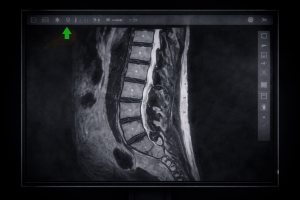
Burn-In vs. Diagnostic Image Quality
From a clinical standpoint, the primary concern are:
- Introduction of image artifacts
- Maintaining clinical visualization guidelines
- Diagnostic Confidence
In properly engineered OLED medical displays:
- Pixel compensation maintains visual consistency
- Any localized aging remains outside critical diagnostic regions
- Image quality remains stable throughout the display’s intended service life
This is why OLED continues to gain traction in medical visualization where contrast performance and clarity are essential.
OLED Displays for Ultrasound, Pathology, and Surgical Viewing
Beyond radiology reading rooms, OLED displays are increasingly used in:
- Diagnostic ultrasound systems
- Digital pathology
- Surgical visualization
- Interventional environments
These applications benefit from OLED’s:
- High contrast and black-level performance
- Wide color gamut
- Fast response time
- Wide viewing angles
- Lightweight and low power
When paired with appropriate system-level engineering, OLED provides a reliable and visually precise solution across a range of medical workflows.
Choosing OLED Displays for Medical Visualization
Selecting an OLED display for medical use requires more than panel specifications alone. Considerations include:
- Intended clinical application
- Usage duration and workflow patterns
- Environmental conditions
- Integration with system software and hardware
We work with established medical product companies and OEM partners to support the design, development, and delivery of custom medical visualization solutions – ensuring display technology aligns with clinical spec needs.
Final Thoughts
OLED burn-in is a valid technical consideration, but it is not a barrier to medical imaging adoption. With quality engineered design, adaptive compensation, and the dynamic nature of clinical imaging workflows, OLED displays can deliver exceptional image quality without compromising diagnostic integrity.
For radiology, endoscopy, ultrasound, and advanced medical visualization, OLED offers a compelling balance of performance, reliability, and clarity when engineered correctly.
Need Help with Medical Display Integration?
Contact our team to discuss OLED, Mini-LED, or LCD display solution options. We engineer for long-term performance and clinical reliability, providing advanced display solutions, customizations, and system integration support for demanding, high complexity applications.