

In modern retail, scale is both a strength and a constraint. For one of the world’s largest retailers, even small inefficiencies multiply into massive operational challenges.
That reality became clear when Walmart began expanding the use of Electronic Shelf Labels (ESLs) across thousands of stores. ESLs promised real-time pricing accuracy, operational efficiency, and improved in-store experience—but they also introduced a hidden challenge: power.
Behind the scenes, Walmart faced a pivotal question. How do you digitize shelves at national scale without overwhelming the power infrastructure that supports them?
The Challenge
Walmart identified a critical risk tied to ESL deployment at scale. Walmart needed to drastically reduce ESL power usage or risk triggering up to $1M per store in power grid upgrades across roughly 5,000 locations. The requirement was simple and unforgiving: cut power without sacrificing readability, contrast, and consistency across thousands of displays.
The Solution
To address this challenge, Walmart partnered with Lincoln Technology Solutions to rethink ESL display design from the ground up. LTS engineered a power-optimized backlighting architecture that delivered huge power savings while maintaining strong visual performance. For the Walmart demo, LTS built a 23.1-inch stretch bar display to represent the shelf-edge deployment form factor and validate the approach at retail scale.

Rather than treating ESLs as commodity displays, LTS approached them as edge-optimized systems, where power efficiency was engineered into the display architecture itself.
Demo Display Highlights (Walmart stretch-bar proof point)
- 23.1” Stretch Bar retail demo format
- Resolution: 1920 × 158
- Ultra-high uniformity: >90%
- Contrast ratio: >100,000:1
- Designed for: low power + high contrast shelf-edge visibility
Measured Power Savings
The demo validated power reduction across a range of real content conditions, including full-white, full-black, color patterns, and video.
Key takeaway: the LTS architecture delivered significant reduction in measured power versus the stock edge-lit approach, with especially strong savings on dark content (a common state for many shelf-edge UI layouts and dimmed retail environments).
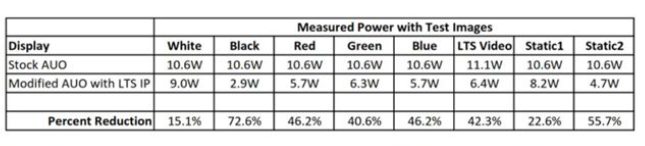
Figure: Measured power comparison (Stock edge-lit vs. LTS optimized architecture) across test images, including white, black, RGB, video, and static patterns.
Outcome
By solving the power problem at the display architecture level, Walmart received a path to deploy ESLs broadly without forcing expensive store-by-store electrical upgrades.
- Avoided costly infrastructure changes at scale
- Supported continued digital shelf expansion
- Estimated $5B in avoided infrastructure costs enabled by LTS’s power-efficient display architecture
Why this Matters for Retail and Digital Signage
This approach is ideal for Retail and Digital Signage applications where high contrast and low power consumption are required, especially in always-on environments where energy use compounds quickly across large footprints.
Exploring large-scale ESL or retail display deployments?
Let’s talk about how power-optimized display architectures can transform your economics—before infrastructure becomes the bottleneck.