
Power that Lasts the Mission
Mini-LEDs with Chip-Scale-Packaging delivers up to 75 % power savings while maintaining luminance uniformity
Drone controller display applications present unique challenges. In addition to demanding a high level of optical performance, drone controller displays must perform in hostile outdoor environments. Another challenging factor in the drone industry is the inherent security concern related to some sensitive use cases.
Lincoln Technology Solutions is well-versed in all of these challenges, and we can provide turn-key display solutions to support these broad-ranging requirements. Our U.S.-based engineering team has the expertise needed to streamline display integration into any drone controller application. From supporting mil-spec reliability testing to designing custom mechanical interfaces, LTS is the partner you need to create rugged solutions.
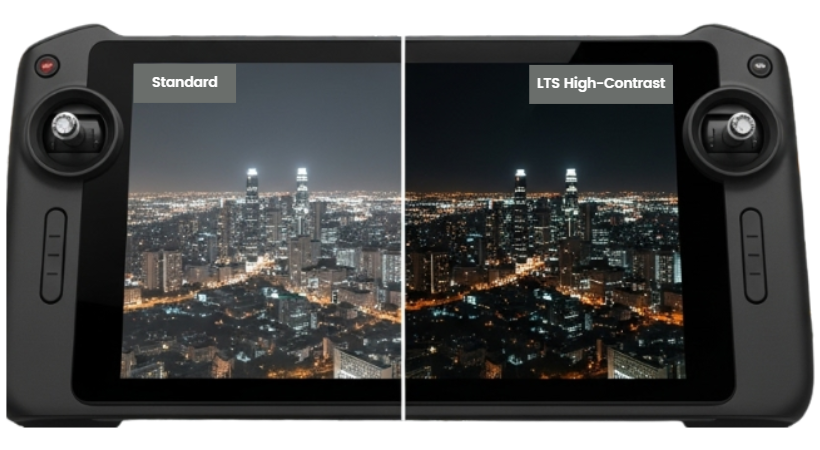
Better contrast and true color reveal critical detail. Off-the-shelf drone controller screens often fade under sunlight, lose contrast in darkness, and drain power too quickly in the field.
Missed cracks during inspection, blurred mapping visuals, or color-shifted footage when precision matters most.



Critical data washed out under sunlight?
LTS’s displays of high luminance up to 5000 NITS proven to reveal sharp edges for lines, grids, and overlays.

Losing detail in shadows or glare?
FALD + OLED deliver true blacks and HDR precision, perfect for mapping and inspection.

Battery draining too fast?
Mini-LED CSP saves up to 75% power with uniform brightness.
Facing rugged field challenges?
IK08 impact, 5G vibration, operates under –30°C to +85°C.

Feels like carrying a brick?
Handheld and portable by design.

Still struggling with application fit?
We build custom displays — and take on the complex projects others avoid.
 Agriculture
  Industrial Inspection
  Public Safety
  Cinematography
  Mapping & Surveying
  Military & Defense
| Your Challenge | Our Solution |
|---|---|
| Crop stress or pest patterns invisible in bright fields | High-resolution clarity (1280×720 to 4K) reveals subtle NDVI differences and crop discoloration for faster, data-backed decisions. |
| Screen washout during mid-day flights | Up to 5000 nits brightness with anti-glare optical coating maintains visibility under direct sunlight or shade. |
| Limited battery life during long field missions | FALD Mini-LED with Chip-Scale Packaging delivers up to 75% power savings while maintaining full-brightness performance for extended drone operations. |
| Your Challenge | Our Solution |
|---|---|
| Hairline cracks and corrosion go unnoticed under low contrast | HDR contrast (OLED/FALD up to 15,000,000:1) makes micro-defects and rust instantly visible during inspection. |
| Small defects blur on standard resolution displays | 4K clarity with FALD precision reveals surface irregularities and fine cracks for higher inspection accuracy. |
| Viewing accuracy drops when sharing screens with colleagues | 178° wide viewing angles maintain uniform brightness and color fidelity across teams and perspectives. |
| Your Challenge | Our Solution |
|---|---|
| Displays unreadable in glare, smoke, or haze during emergency response | Mission-critical visibility. 3000–5300 nits brightness cuts through glare, smoke, and searchlights for clear visuals in high-stress environments. |
| Details lost in low-light or obstructed emergency scenes | Clarity in chaos. Superior HDR contrast reveals critical details even in dim or visually obstructed conditions. |
| Display failure under temperature or weather extremes | Reliable in every condition. Rated –30°C to +85°C for consistent performance in heat, cold, fog, and humidity. |
| Your Challenge | Our Solution |
|---|---|
| Colors and exposure appear inaccurate on standard field monitors | True-to-life color accuracy. OLED and FALD 4K displays reproduce 97% DCI-P3 gamut for consistent framing and grading. |
| Glare and reflections distort framing during outdoor shoots | Daylight-proof brightness. Up to 5000 nits with anti-reflective coating ensures perfect visibility under harsh sunlight. |
| Video lag affects real-time framing and movement precision | Low-latency response. <5 ms response time keeps live footage synchronized with camera motion. |
| Your Challenge | Our Solution |
|---|---|
| Fine elevation lines or terrain edges are hard to distinguish on standard displays | Ultra-sharp 4K resolution. Captures subtle contour differences and elevation details for accurate geospatial mapping. |
| Screen glare and ambient light distort map visibility in outdoor fieldwork | Sunlight-readable brightness. Up to 5300 nits with anti-glare coating ensures crisp visibility under direct sunlight. |
| Battery drains quickly during extended mapping flights | FALD Mini-LEDs with Chip-Scale Packaging provide up to 75% power savings while maintaining full brightness and luminance uniformity. |
| Your Challenge | Our Solution |
|---|---|
| Displays fail under vibration, shock, or harsh weather conditions | Rugged, mission-ready design. IK08 impact-rated and 5G vibration-tested for reliability in field and tactical use. |
| Visibility compromised by glare, sand, or snow reflection | All-weather readability. High-bright displays up to 5000 nits maintain visibility in extreme daylight and reflective conditions. |
| Incompatible with night-vision or low-light tactical operations | NVG-compatible visibility. Adjustable low-brightness and deep-black OLED modes ensure stealth-ready performance in darkness. |


Tell us your controller or GCS requirements. We will recommend the best fit and ship a sample.


The display determines how clearly pilots and operators can view real-time visuals and flight data. Poor sunlight readability or low contrast can lead to missed details in mapping, inspection, or cinematography. Choosing a high-bright, rugged display ensures accuracy, safety, and longer operation time.
Sunlight-readable displays use high brightness levels (2000–5300 nits), anti-reflective coatings, and optimized polarizers to remain visible under direct sunlight. These technologies prevent glare and color washout — ideal for outdoor drone operations.
Each display type offers unique advantages: LCD provides high brightness and durability, OLED delivers true blacks and vivid colors, while Mini-LED FALD offers HDR-level contrast with up to 75% power savings. The right choice depends on mission type and environment.
Drone pilots operate in bright outdoor conditions. Displays with 2000–5300 nits brightness ensure clear visibility even under direct sunlight, preventing loss of critical data or image details during flight.
Display sizes between 7″ and 10.1″ are most common for handheld GCS units, balancing portability with readability. Larger 13.3″–18.5″ displays are used for desktop or mounted control stations requiring detailed image analysis.
Accurate color reproduction ensures reliable image interpretation for NDVI, crop analysis, surface inspection, or cinematography. Displays covering up to 97% DCI-P3 color gamut provide lifelike visuals for precise decision-making.
Rugged displays are engineered to withstand vibration, impact, and temperature extremes. LTS displays are IK08 impact-verified, 5G vibration-tested, and rated for –30°C to +85°C, ensuring consistent performance in demanding outdoor missions.
Power-efficient displays reduce the load on the system’s battery, extending mission time. LTS Mini-LED FALD displays use Chip-Scale Packaging (CSP) for up to 75% power savings without compromising brightness or clarity.
4K resolution provides four times the pixel detail of Full HD, allowing operators to see fine textures, edges, and defects. It’s essential for high-precision tasks like industrial inspection, cinematography, and surveying.
Standard displays typically range from 300–500 nits, which is insufficient outdoors. High-brightness displays (2000+ nits) feature enhanced LED backlights and optical films, maintaining clarity in direct sunlight and reflective environments.
Yes. LTS specializes in custom display manufacturing, offering size options from 1″ to 32″. Displays can be tailored for handheld controllers, dashboards, or rack-mounted ground stations.
Yes. Most LTS drone displays can be configured with capacitive (PCAP) or glove-friendly touch panels, ideal for industrial, outdoor, or mission-critical use.
Yes. OLED and Mini-LED FALD displays from LTS offer HDR-level contrast and true blacks for clear visibility during nighttime or low-light drone missions.
LTS displays undergo multiple environmental tests, including IK08 impact, 5G vibration, UV exposure, thermal shock, and humidity cycling. Each unit is verified for reliability under real-world stress conditions.
LTS displays are used across agriculture, industrial inspection, mapping and surveying, cinematography, public safety, and defense — where clarity, ruggedness, and precision are mission-critical.
LTS combines high brightness, color accuracy, and rugged engineering in every display. With proven reliability from –30°C to +85°C and customized designs, LTS displays outperform standard off-the-shelf screens in the field.
Yes. LTS partners with system-on-module (SOM) and embedded platform providers to offer pre-integrated display solutions that reduce development time and ensure seamless performance for drone manufacturers.
Absolutely. LTS displays are designed for handheld controllers, desktop control stations, and vehicle-mounted consoles, ensuring flexibility across drone applications.
Unlike consumer-grade panels, LTS industrial displays are optimized for brightness, durability, thermal stability, and color precision, ensuring consistent performance in outdoor and high-duty-cycle environments.
Yes. LTS provides long lifecycle support, ensuring component consistency, ongoing availability, and engineering assistance for OEM partners in commercial and industrial drone markets.
Each drone segment has unique visual demands — from color-critical cinematography to rugged defense operations. LTS designs purpose-built displays that combine high brightness, contrast, color accuracy, and durability to ensure clarity in every condition.
Agriculture drones require true color accuracy and sunlight readability for NDVI and crop stress analysis. LTS high-bright displays (up to 5300 nits) and 97% DCI-P3 color gamut make subtle field variations visible, enabling faster, more accurate farm decisions.
Industrial inspection requires high contrast and high resolution to detect micro-defects. LTS OLED and Mini-LED FALD displays highlight cracks, rust, and corrosion with exceptional sharpness and contrast — improving inspection precision and safety.
Mapping drones demand high pixel density and extreme brightness to visualize elevation lines, boundaries, and terrain edges. LTS 4K and high-resolution LCDs provide sharp detail and readability under direct sunlight, ensuring survey accuracy.
Cinematography drones rely on color accuracy, brightness, and low latency for precise framing and real-time monitoring. LTS OLED displays deliver lifelike color and true contrast, guaranteeing footage consistency even under harsh lighting.
Public safety operations need displays visible in smoke, haze, or glare. LTS ultra-high brightness panels (3000–5300 nits) and high contrast ratios ensure critical visuals remain clear in low-visibility environments, supporting faster, safer decision-making.
Defense drones require ruggedized, all-weather displays with high brightness, shock resistance, and night-vision compatibility. LTS offers IK08 impact-rated, 5G vibration-tested displays proven to perform from –30°C to +85°C in mission-critical environments.
LTS rugged displays undergo impact (IK08), vibration (5G), thermal shock, and humidity testing. They maintain brightness and clarity under sunlight, rain, heat, or cold — ensuring uninterrupted performance in the field.
Color accuracy directly affects analysis reliability. LTS displays with up to 97% DCI-P3 coverage provide precise color reproduction for NDVI mapping, inspection imaging, and cinematic editing — ensuring data integrity and visual consistency.
Controllers often run on limited battery capacity. LTS Chip-Scale Packaging (CSP) Mini-LEDs provide up to 75% power savings while maintaining brightness uniformity, extending operation time without sacrificing performance.
Yes. LTS designs custom display modules from 1″ to 32″ to fit handheld controllers, dashboards, or rugged cases. Displays can include PCAP touch, cover glass, and custom optical stacks to match exact design requirements.
Yes. Many LTS drone displays integrate PCAP touch technology optimized for glove and stylus input, enabling seamless control in industrial or outdoor conditions.
Consumer screens lack the brightness, temperature tolerance, and durability needed for field use. LTS displays deliver up to 10× higher brightness, rugged construction, and industrial reliability designed for professional drone systems.
Yes. LTS displays support standard interfaces such as MIPI, HDMI, and LVDS, making them compatible with major System-on-Module (SOM) platforms and embedded drone control architectures.
Absolutely. LTS offers displays for compact handheld units as well as large, fixed ground stations, maintaining consistent visibility and reliability across configurations.
Every LTS display is factory-calibrated for uniform brightness and color using automated optical inspection systems. This guarantees consistent performance and visual quality across production runs.
Yes. LTS partners with OEMs to provide mechanical design files, interface validation, and prototyping support to accelerate integration and reduce time-to-market.
LTS displays are used globally in agriculture, industrial inspection, mapping, cinematography, public safety, defense, and utilities — industries where visual clarity and reliability drive mission success.
© Copyright 2024 – present Lincoln Technology Solutions. All Rights Reserved.
Designed and Maintained by MRN Designs


